A successful low-carbon energy transition depends on new technology, creative business models and innovation moving forward. DSOs will face many challenges when large scale distributed generation will be integrated, with high numbers of electric vehicles (EVs) connected to the grid and prosumers interacting in the market. More active grids will require a more advanced monitoring and management of the grid, for which innovation technologies are needed. A recently published EURELECTRIC paper entitled Innovation incentives for DSOs – a must in the new energy market explains why DSOs need more innovative investments to succeed in the new EU electricity development market. It also calls on policy makers to encourage national regulatory authorities (NRAs) to give DSOs appropriate incentives to implement the necessary innovative initiatives that support the transformation of the DSO business models.
 DSOs have an important role to play in the EU energy transition, as they are responsible for the deployment of smart grids and contribute to the development of smart energy systems, whilst maintaining the smooth operation of the networks. This challenging job requires increasingly innovative solutions. Together with other market parties, more focus on innovation is needed to understand how to make the best use of new technologies opportunities to maintain high levels of security of supply at the most efficient cost. Innovation is also important due to the increasing need for investments in the ageing European distribution networks.
Most DSOs have to change their business models and internal processes in order to implement innovative solutions and technologies, to help the transition to th
e new energy market. Policy makers should encourage NRAs to give DSOs appropriate incentives to implement the necessary innovative initiatives. Meanwhile, it is important that NRAs monitor whether DSOs achieve scheduled goals.
The implementation of innovation incentives should target the reduction of
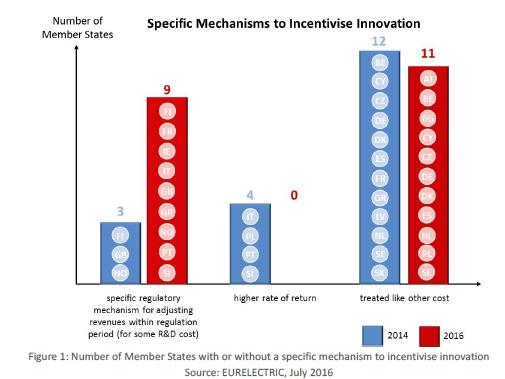
financial risk for DSOs while increasing their participation in pilot projects and innovative programs. Innovation investments for smart grids are hard to predict before the establishment of a regulatory period. Moreover, they depend highly on the regulatory scheme, which is constantly evolving. A lot of R&D and innovative projects have to be conducted and finally, only a few of these technologies will lead to commercial introduction on the market. Therefore, regulators should also bear in mind that the degree of customer and technology readiness could determine what design of incentive is best suitable for the stage of innovation needed.
In order to help DSOs innovate, the implemented specific regulatory mechanisms should be predictable and stable in the outcome. Regulation that efficiently incentivises DSOs to engage in active system management has to consider the changing OPEX and CAPEX structures, acknowledging the shift from a higher share of CAPEX to OPEX in the deployment of new innovative network technologies. Moreover, regulation has to find the optimal balance between using distributed generation and building new infrastructure, and how to incentivise DSOs to be innovative and find solutions (e.g. for ICT, data handling, but also system services) in-house or by outsourcing.
The paper includes the results of a survey conducted by EURELECTRIC on incentives for innovation within 20 Member States and further recommendations to the national regulatory frameworks on how to better foster smart grid innovation.